- +1 (845) 367-4240
- info@colonialpropertymanagement.com
- 410A New York 59, Airmont, NY 10952, USA

Generative AI can’t replace professional property management. The answer gets clearer once you look past the trend. Most teams now use AI. Almost no team grants it full operational control. The discourse of “AI vs. property managers” comes from a clear understanding: managing homes means managing risk, money, and real relationships.
Buildium’s 2026 report shows adoption jumped from 20% to 58% in a single year. Yet only 8% of teams have fully automated even one workflow. Among teams that understand how to implement AI into their operations, barely one in four has put it into practice (Building Engines). If experts in the field refuse to hand over full control, why would an owner stake rental income on it?
Generative AI fails to deliver these three points: when it sets prices using competitor data, when it screens tenants without human judgement, and when it drafts legal documents without supervision. In business, the liability for these mistakes doesn’t land on the AI vendor, it lands on the housing provider.
Before looking at where AI fails, it helps to establish what owners are actually paying for. Buildium’s 2026 State of the Property Management Industry Report asked rental owners what they value most:
74% said customer service
55% said local market expertise
52% said reporting and transparency
30% said regulatory expertise
25% said technology use
Technology ranks fifth. Sitting below customer service, local market expertise, reporting, and regulatory expertise. Owners aren’t asking for AI integration. They’re asking for the outcomes AI should deliver: strong resident relationships, transparent financial reporting, and long-term asset performance.
Property management is a people-focused endeavor. As Calynne Oyolokor, senior vice president of multi-family at First Service Residential, puts it: “Strong resident relationships drive satisfaction, and resident satisfaction is linked to higher retention rates and long-term asset performance”.
New technologies give property management companies new avenues for sustainable growth, without compromising on service standards. The challenge isn’t whether to adopt AI or how to implement it. It’s knowing when the tool stops being useful, and professional judgement needs to take over.
| What Does AI Do Best in Property Management? |
|---|
| Brainstorming and Ideation: Generating listing descriptions, drafting talking points for owner meetings, exploring tone variations for resident communications, producing first drafts of marketing copy. |
| Drafting routine resident communication: When trained on a firm's templates, policies, and procedures, AI can produce a working first draft of a maintenance update, a renewal reminder, or a community notice. A staff member still reviews, edits, and sends. |
| Surface-level Translation: Helping English-speaking managers communicate with Spanish-speaking residents, and vice versa. Not a replacement for a bilingual staff member in sensitive situations, but a genuine bridge for routine exchanges. |
| Lead Capture: AI-powered leasing assistants can answer common questions from prospects at any hour, schedule tours, and capture contact information for follow-up. |
| When Does AI Stop Being Useful In Property Management? |
|---|
| Maintenance coordination: generative AI can summarize a request: It can’t call a technician, source parts, or read a resident’s tone on complex situations. |
| Tenant relations and dispute resolution: AI can route communication, but can’t de-escalate a complaint or have a delicate conversation with residents or vendors. |
The difference between a property manager using AI as an assistant vs. an autonomous operator lies in accountability. One uses the tool as a research assistant, a first-draft writer, and a 24/7 inbound communication channel. The other one creates liability by relying on its autonomy.
The distinction matters: a property manager who lets AI send resident letters without review adds efficiency and liability in roughly equal measure. AI can generate weekly reports, per property, on a national level. But the data accuracy must be supervised, and the data banks feeding the AI have to be curated and monitored. A report without a data analyst reviewing it isn’t actionable.
When the distinction between tool and autonomous operator gets ignored, the consequences cross legal territory. Here’s a look at what happens when companies let AI tools recommend rent pricing, manage tenant screening and write legal documentation autonomously.
When AI stops being used as an assistant and is left to run autonomously, consequences could trigger federal antitrust lawsuits, fair housing complaints, and procedural dismissals in court. Three services offered by AI vendors illustrate this pattern clearly: rent pricing, tenant screening and legal document generation.
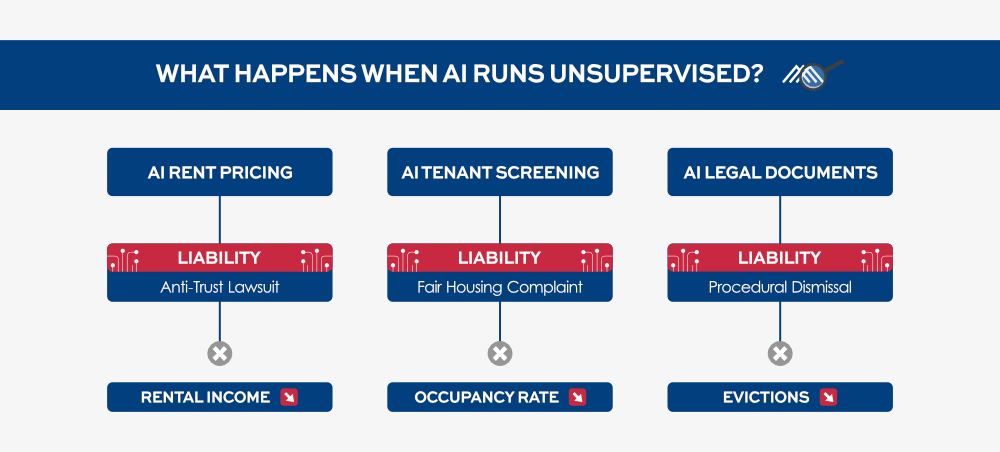
In November 2025, the U.S. Department of Justice filed a proposed settlement against RealPage, a revenue management software provider. The settlement forced the company to stop using non-public competitor data, eliminate market surveys, and cease issuing identical pricing recommendations to different owners in the same market (Federal Register publication, January 2026).
The core allegation: these algorithms allow for owners to coordinate rates, restrict house supply and artificially drive up rents by sharing sensitive, non-public pricing and occupancy data. They eliminate competition by manipulating the market. As a result, multi-million dollar settlements have barred major property management firms (such as Greystar and LivCor) from using external non-public data to generate rental prices.
AI tenant screening automates evaluation of rental applications by cross-referencing databases, but it demands regulatory scrutiny. The U.S. Department of Housing and Urban Development requires landlords and third-party AI to remain compliant with the Fair Housing Act.
Property managers can be held liable for unlawful discrimination and automatic rejection caused by the algorithm. The AI algorithm scores credit history and non-rental debt in ways that unjustly deny applications. The most recent case, dated January 13, 2026, resulted in a settlement that required statewide revision of 330+ properties managed by Greystar California. Without admitting liability, the company agreed to review their screening procedures and provide local housing protection training to their leasing staff. The Fair Housing Act doesn’t care whether the algorithm made the decision. It cares that the landlord deployed it.
Even a recommended use (like AI-assisted drafting) can carry legal risk when unsupervised. The Connecticut Supreme Court is actively handling a case involving a landlord-tenant dispute where the Wallingford-based law firm submitted legal briefs containing fake citations generated by AI.
Conversational AI models generate text (including numeric values) using predictive patterns. The generated text is not driven by meaning, but by predictive context. Sometimes fictitious citations, or “hallucinations” slip through because the model assumes what a citation looks like. These cases aren’t isolated, but they showcase an existing pattern: When AI stops being used as a tool and becomes an autonomous operator, the liability lands on the housing provider.
The truth is that AI in property management has been regulated like any other business, existing rules applied to new technology. When AI pricing tools aggregate competitor data, AI screening tools produce discriminatory outcomes, or AI-driven advertising misleads consumers, the liability still falls on the housing provider.
Now that’s starting to change. New York passed a law that bans coordinated rent pricing by algorithm, with serious penalties attached. Other states are following with similar bans. In RealPage v. James, the company argues that the First Amendment protects algorithmic price recommendations; but the law targets the shared data and math behind the recommendations, not the words themselves. A court ruling is pending, and its outcome will likely shape how AI is regulated in rental housing nationwide.
AI can’t replace a property manager. As with any tool, the difference lies in learning what it is useful for. The property managers who will make the most out of new technology won’t be the ones who refused adoption, or the ones who implemented it everywhere. They’ll be the ones who know exactly when to step in and finish the job themselves.
The industry that knows the technology best has already answered: adoption is high, but only 8% of teams have fully automated a single workflow. That hesitation isn’t fear of change, it’s the recognition that managing homes demands the judgement AI doesn’t possess.
Make sure you and your property manager are aligned on the following. Ask for:
Yes. Under the Fair Housing Act, housing providers remain liable for discriminatory decisions even when those decisions come from AI. Outsourcing the decision to an algorithm does not shift the legal responsibility.
Pricing depends on the level of AI involvement and how much human oversight stays in place.
While AI options can look cheaper upfront, pricing transparency remains a major issue — many providers don’t disclose their full fee structure.
In property management, AI delivers the best results when every action stays supervised, avoiding liability.
Important Note: This post is for informational and educational purposes only. It should not be taken as legal, accounting, or tax advice, nor should it be used as a substitute for such services. Always consult your own legal, accounting, or tax counsel before taking any action based on this information.