- +1 (845) 367-4240
- info@colonialpropertymanagement.com
- 410A New York 59, Airmont, NY 10952, USA

Lease Expiration & Total Vacancy Risk
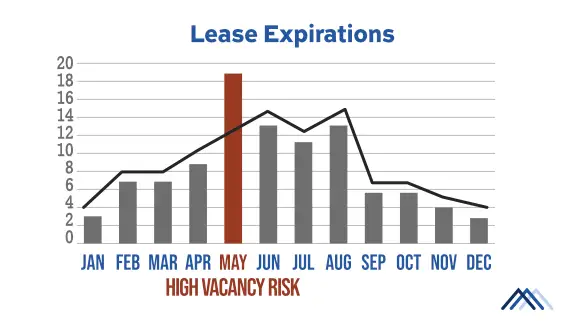
A lease expiration profile is a spreadsheet that tracks every unit’s lease end date, notice status, and renewal probability. It shows the timing and concentration of the lease expirations in a property, which allows us to predict the turnover and income stability of your property portfolio.
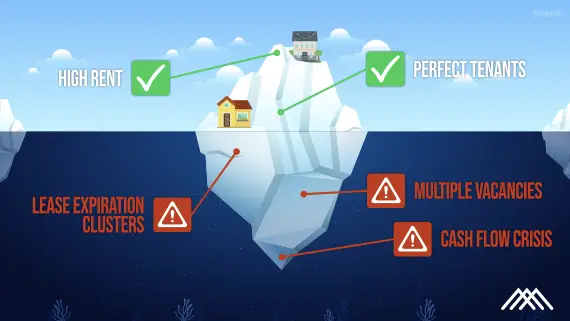
Spreading your lease expiration dates is the most effective strategy to prevent cash flow crises and protect asset value. A property with simultaneous expirations risks total vacancy, forcing urgent leasing at below-market rates that destabilizes your income.
A good lease renewal strategy not only helps you fill units, but most importantly gives you the power to predict your income, eliminate crisis management, and maximize your property’s long-term value.
According to the National Apartment Association, the average cost of a vacancy (including lost rent, turnover repairs, and marketing) exceeds 1.5x monthly rent. In our experience managing properties in Dutchess County, clustered expirations push that cost to over 2.2× monthly rent due to rushed marketing and lower tenant quality.
By avoiding the need to lower rent prices in a crisis, you can negotiate on your own terms and protect your asset value.
Lease expiration profiles directly determine your portfolio’s risk exposure and income predictability. For example, in rental markets that continue to experience low vacancy rates, like with Dutchess County, a cluster of lease expirations can force you to compete against yourself, lowering rents and tenant quality just to fill units.
In Dutchess County, New York, the number of multi-family units being built is increasing rapidly since 2020, yet the county’s vacancy rate in 2024 is three percent below the healthy vacancy rate.
Even though a low vacancy rate is fundamentally good for business, it’s a risk when leases expire in a cluster. In this scenario, a 10-unit building where 4 leases expire in the same month transforms into a crisis. This occurs the moment you have to list and lease 4 identical units in the same narrow timeframe. Each unit you own competes with itself, forcing you to accept lower rents and weaker tenant profiles to avoid extended vacancies. Staggering your lease renewals helps you efficiently avoid this crisis and retain your income.
Now that you understand the value of a lease expiration profile, the following guide will teach you how to calculate vacancy risk and plan your lease renewals.
Gather every active lease agreement for your property. Plot each expiration date on a 12‑month calendar. A clustered profile has multiple leases expiring in the same 1‑2 month window, while a healthy one shows lease end dates spaced evenly throughout the year.
What to look for? Identify the consecutive 60‑day window where the highest number of leases expire. That’s your period of maximum vacancy risk.
Use this formula to calculate the risk of total vacancy in your muti-family portfolio during your busiest 60‑day window:
How to interpret the score:
For properties at high risk of vacancy, score each tenant on a 1-10 scale using payment consistency, communication, lease compliance, and renewal likelihood. Keep the tenants scoring 8-10. Replace those scoring 1-3. This will help you plan your renewals strategically.
See our Tenant Predictability Index for the full scoring method.
Your compliance deadlines depend on three factors: whether the unit is rent‑stabilized, whether the property is in a “Good Cause” municipality (e.g., Albany, Kingston, Newburgh), and the tenant’s total length of stay.
Navigating renewal laws is where strategy meets compliance. Missing a deadline can forfeit your right to increase rent or even renew the lease at all. Here’s what you need to know to stay compliant with your local laws.
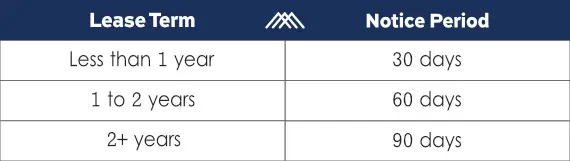
For market-rate apartments, New York State law requires written notice for renewal or a rent increase over 5%. The timeline depends on your tenancy length:
For property owners, this means your planning timeline is set by your most restrictive lease. While planning 90 days ahead is a general rule, some portfolios start the renewal process 150 days or more in advance.
Colonial Property Management services ensure legal compliance in New York and Connecticut. Our lease renewal strategies are built with all applicable notice period laws in mind.
Tracking these varying rules across a portfolio is a complex, high-risk task. This is where our expertise becomes your strategic advantage. Colonial Property Management simplifies the entire process by acting as your dedicated property manager for your rental properties.
Look for proactive deadline tracking, legal compliance monitoring (including rent‑stabilized and Good Cause laws), and strategic lease staggering support. The best services help you avoid income disruption by starting the renewal process 90 to 150 days in advance for regulated properties.
Yes. You can proactively stagger renewals by offering different lease lengths when tenants renew. This spreads expirations across the year. Start the renewal process early, at least 90 days in advance for most properties. This gives you time to negotiate or find new renters if needed.
A lease expiration profile is a report that tracks every unit’s lease end date. It helps property owners see when too many leases expire at the same time, which can increase vacancy risk. To calculate your risk, identify the 60‑day window with the most expirations; if it exceeds 30‑40% of your units, you have a high-risk cluster.
Staggering lease expiration dates prevents a sudden loss of rental income. If many leases end in the same month, you may be forced to lower rents and accept weaker tenants just to fill vacancies. Spreading expirations throughout the year protects your cash flow and property value. A high-performance strategy is to keep less than 10% of your units expiring in any given month.